

Call Us Now
Call Us Now


No—your HOA cannot ban solar panels in Texas. State law protects your right to install solar, but your HOA can apply reasonable restrictions on placement, design, and visibility—as long as those rules don’t significantly increase costs or reduce system performance.
If you live in an HOA community, going solar might feel complicated—but the law is actually on your side. Understanding how it works helps you avoid delays and get your system approved faster.
If you’re worried your HOA can stop you from going solar, Texas law provides strong protections. Under Texas Property Code Section 202.010, HOAs are not allowed to prohibit solar energy devices on residential properties.
This means any rule in your HOA’s governing documents that effectively bans solar panels is legally unenforceable.
However, this doesn’t mean you can install panels without any oversight. Your HOA still has the authority to enforce reasonable rules related to aesthetics and placement. The key factor is that these restrictions must not make your system too expensive or inefficient to install.
In simple terms, the law creates a balance: You have the right to go solar, and your HOA has the right to maintain community standards—within limits.
Your HOA can regulate how your solar system looks and where it’s placed, but only within what the law considers “reasonable.”
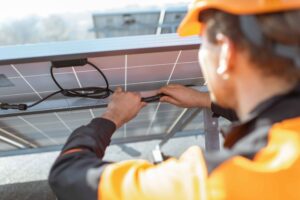
Most commonly, you may encounter rules related to:
What your HOA cannot do is impose restrictions that:
These thresholds are important because they give you a clear standard to evaluate whether a rule is fair or legally challengeable.
Ground-mounted systems are usually more restricted due to visibility concerns, so if you’re planning one, expect closer review.
Before installing solar panels, you’ll need to go through your HOA’s approval process. While this may sound intimidating, it’s manageable when you’re properly prepared.
Typically, you’ll need to submit:
Once submitted, your HOA will review the application based on its architectural guidelines. Response times vary, but they must act within a reasonable timeframe outlined in their governing documents. HOA review is one step in the broader project schedule — see how long it takes to install solar panels in Texas for where it fits.
One of the best ways to avoid delays is to submit a complete and professional application from the start.
If your application is denied, don’t assume it’s the end of the road. In many cases, denials happen due to incomplete documentation or concerns that can be addressed.
Start by requesting a written explanation. This will help you understand exactly what needs to be corrected.
From there, you can:
If your HOA’s restrictions go beyond what Texas law allows, such as significantly increasing costs or reducing efficiency, you may have grounds to challenge the decision legally.
 Yes, the type of solar system you choose can affect how your HOA evaluates your application.
Rooftop systems are the most common and usually the easiest to get approved. They tend to blend with your home’s structure and are less visible from the street.
Ground-mounted systems, on the other hand, often face stricter scrutiny. Because they are more visible, many HOAs impose additional rules—or discourage them entirely.
If you’re considering battery storage or solar carports, these may also require additional review, especially if they involve visible equipment or structural additions.
Getting your solar project approved often comes down to preparation and communication. When you approach the process strategically, your chances of success increase significantly.
Here’s what helps most:
When you show that your installation meets both legal standards and community expectations, approvals tend to move much faster.
Even with HOA involvement, solar panels are still a strong investment for most Texas homeowners. The legal protections in place ensure that you can move forward, while the financial benefits remain the same — our complete cost-benefit analysis of whether solar panels are worth it in Texas runs the full numbers.
You can still:
The key difference is that you’ll need to take a few extra steps during the approval process—but those steps are manageable with the right support.
Yes, you can install solar panels even if you live in an HOA community in Texas. While your HOA can enforce reasonable design and placement rules, it cannot deny your right to go solar.
By understanding your rights, preparing a strong application, and working with experienced professionals, you can successfully navigate the process and start enjoying the benefits of solar energy. For everything else — sizing, costs, incentives, and permits — see our complete homeowner’s guide to home solar panels in Texas.
Don’t let HOA concerns stop you from going solar. Contact us today for a free consultation. Let our team at Big Texan Solar design an HOA-compliant system, handle the paperwork, and help you maximize your savings—without the hassle.
No. Texas law prevents HOAs from banning solar energy systems. Any rule that does so is unenforceable.
A restriction becomes unreasonable if it increases your cost by more than $2,000 or reduces system efficiency by more than 10%.
Yes. You must submit an application and receive approval before installation begins.
Timelines vary, but HOAs must respond within a reasonable timeframe defined in their governing documents.
Yes, as long as the requirements don’t significantly increase costs or reduce performance.
Yes. They are more visible and often face stricter HOA regulations than rooftop systems.
You can revise your plans, resubmit your application, request clarification, or pursue mediation or legal options if the denial violates Texas law.
In most cases, yes. Homes with solar panels often sell faster and at higher prices, especially when systems are owned and professionally installed.